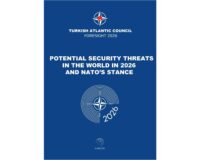
EXECUTIVE SUMMARY: FORESIGHT 2026
Comprehensive Strategic Assessment of the Evolving Global Security Landscape
Published by: The Turkish Atlantic Council & The Hariciye Center for Foreign Policy and Security Studies
Overview
Foresight 2026 presents a rigorous yet realistic analysis of what will shape the transatlantic agenda in the coming year. We are passing through a period defined by the erosion of established international norms and the near-paralysis of multilateral institutions—most notably the UN Security Council. It is precisely at this juncture that the report navigates the complexities of an increasingly fragmented global order.
Key Strategic Themes
It is projected that the following five critical pillars will define the security architecture of 2026:
1. NATO’s Institutional Transformation
The 2025 Hague Summit was a watershed moment; Allies signed off on a historic 5% defense spending target. The Alliance is currently undergoing a profound conceptual shift driven by this commitment.
● Ceaseless Reform: Relationships are no longer purely transactional. NATO is adapting to a new era requiring continuous adaptation.
● Value-Based Solidarity: The report examines the transition toward a deeper, value-driven cohesion to overcome internal debates regarding burden-sharing and political unity.
● Deterrence Redefined: Defense strategies are being re-conceptualized from the ground up to meet modern threats.
2. The Militarization of Space
Space is no longer the “sanctuary” of the past; it has rapidly evolved into a critical risk domain. The report provides a technical dissection of the issue:
● ASAT Capabilities: The dangerous proliferation of Anti-Satellite systems.
● Co-orbital Systems: The rise of highly maneuverable space assets.
● Space Warfare: The integration of kinetic and non-kinetic threats challenging orbital security. In short, space is now a theater of conflict.
3. The “New Balkans” & European Security
The analysis makes a clear determination: the Balkans have transitioned from a “buffer zone” to the direct “front line” of European security.
● Ukraine-Russia Impact: The ongoing war has fundamentally altered regional dynamics.
● Democratic Resilience: Strengthening institutions against external influence is vital.
● Turkey’s Role: A specific emphasis is placed on Turkey’s strategic position as a balancing regional power essential for stability.
4. Crises in the Middle East & Global Order
The persistent instability emanating from the Middle East and its global reverberations are covered extensively:
● Regional Flashpoints: The aftermath of operations in Gaza, state-building challenges in Syria, and the escalation of Israel-Iran tensions are all on the table.
● Fragmentation of Order: While ad hoc coalitions rise, the “normalization” of political gains achieved through military force stands out as a disturbing trend.
5. Public Diplomacy & Strategic Communication
Acknowledging public opinion as a tangible power factor in international relations, the report offers a candid assessment of NATO’s communication posture.
● Lessons Learned: Narrative failures, such as those during the withdrawal from Afghanistan, are reviewed.
● Future Strategy: The report seeks methods to effectively counter disinformation and establish a genuine connection with the Global South to restore eroded trust.
[Read the Full Report]